How to read a British silver hallmark, one punch at a time
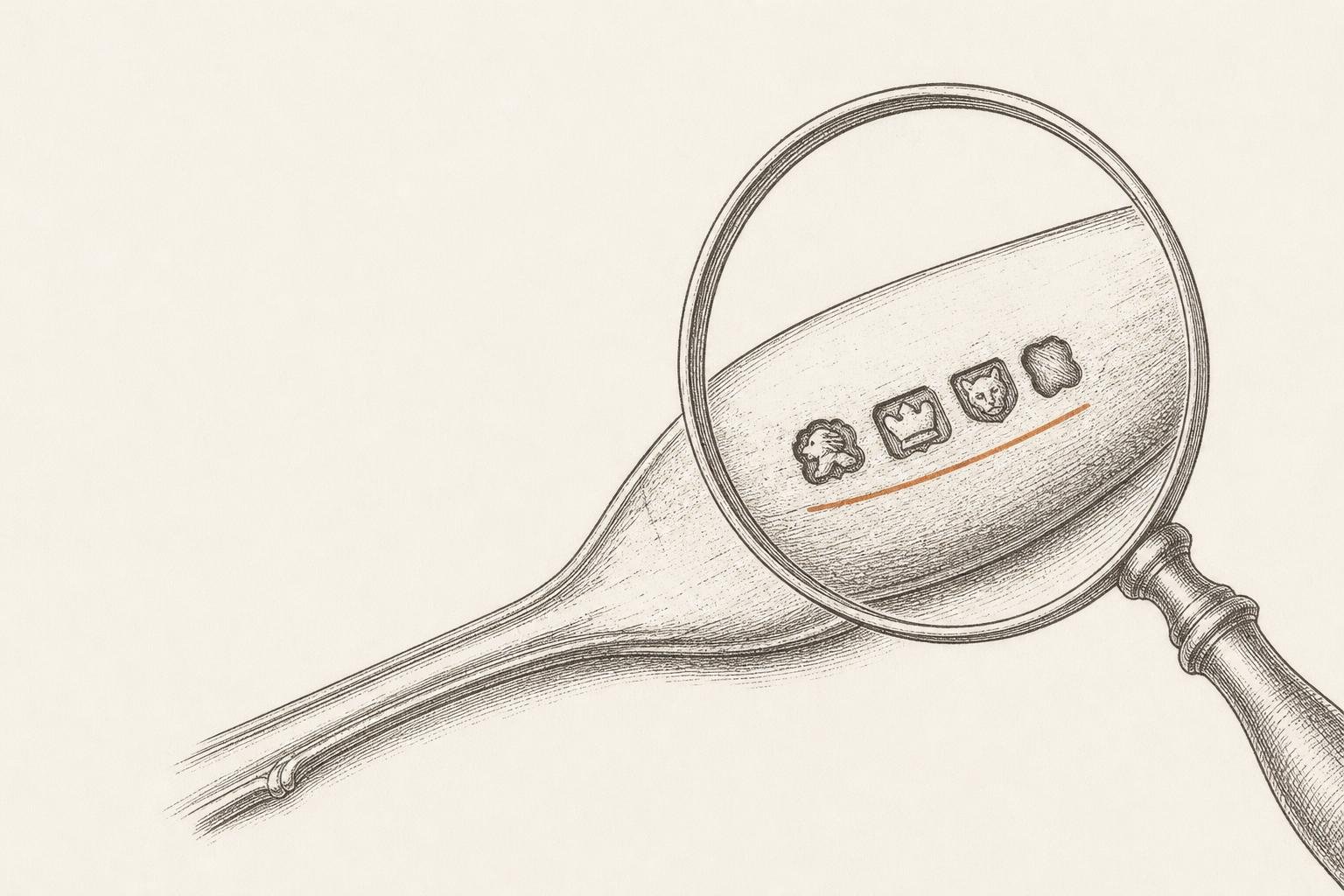
A full British silver hallmark is normally four separate punches, and the quickest way to decode one is to sort them by job rather than by position on the metal. The standard mark tells you what the metal is: in England, a small lion walking with one forepaw raised, the lion passant, means sterling. The town mark tells you which assay office tested it, a leopard's head for London, an anchor for Birmingham, a crown for Sheffield before 1975, a castle for Edinburgh, a crowned harp for Dublin. The date letter is a single letter whose typeface and shield shape pin the year, but only once you know which office. The sponsor's mark, usually two or three initials in a shaped surround, names the maker or the firm that submitted the piece for testing.
Those four went on in a specific order, and the order is genuinely useful. The sponsor's mark was struck first, in the workshop, before the piece ever travelled to the assay office. Everything else was added at the office, in one session, by one pair of hands. So the sponsor's mark is the punch most likely to sit at a slightly different angle, or in a slightly different depth of strike, from the other three. When all four look like they were applied by the same hand in the same minute, on an item that should predate machine uniformity, that is worth a second look.
Punch one: the sponsor's mark, struck in the workshop
This is the initials. Two letters usually mean an individual silversmith, three or four often mean a firm or a partnership. The surround matters as much as the letters: the same initials inside a rectangle, an oval, a shaped cartouche and a punch with a pellet between the letters can be four different registrations, sometimes the same person at different dates, sometimes unrelated people in different cities.
This is also the punch you cannot resolve from first principles. The letters mean nothing without a directory of registered marks for the relevant assay office, and the good directories are organised by office and by punch shape, not alphabetically by initial. At a sale, treat the sponsor's mark as the thing you photograph and look up later. It is the last of the four to reward guessing, and the first to send people down a wrong path, because plenty of initials are shared by a famous maker and an obscure one.
Punch two: the standard mark, which answers the only urgent question
If you have ninety seconds with an object, spend them here. The standard mark is the assay office saying the metal passed a test.
- Lion passant: sterling, 92.5 per cent silver, English offices.
- Britannia, a seated female figure: the higher Britannia standard, compulsory for a spell from 1697, optional afterwards and revived on some later work.
- Thistle: Edinburgh sterling for much of its history, with a lion rampant for Glasgow.
- Crowned harp: Dublin.
- A number such as 925 in a shaped surround: modern practice, since fineness figures became the compulsory way to express the standard in 1999.
What matters just as much is the absence of a standard mark. Electroplate carries no lion passant, because there is no assay. If you see letters like EPNS, EP, A1, or a string of small pictorial punches that look hallmark-ish but resolve into a made-up sequence, you are almost certainly holding plate over a base metal. Victorian platers were fond of pseudo-hallmarks precisely because a row of small shields reads as authority at arm's length. Look for the lion, and look for it to be a lion rather than a generic quadruped.
Punch three: the town mark, which tells you where it was tested
The town mark is the office, not the workshop, and the distinction trips people up. A piece assayed in Birmingham was not necessarily made in Birmingham, only submitted there.
The common ones are learnable in an afternoon. London's leopard's head wore a crown until 1821 and lost it afterwards, which is a free date bracket if the rest of the mark is worn. Birmingham's anchor and Sheffield's crown both arrived when those offices opened in 1773, and they are the pair most often confused at speed, because a rubbed anchor and a rubbed crown can both read as a small blob with arms. Sheffield swapped the crown for a Tudor rose in 1975. Chester used three wheatsheaves and a sword, Newcastle three castles, Exeter and Glasgow and Dublin each their own. Offices closed over time, so the town mark alone can put an outer limit on the date.
Punch four: the date letter, the one that needs a table
The date letter is a single letter in a cycle, usually of twenty or twenty-five letters, with J commonly omitted. Each office ran its own cycles and changed its own typeface and shield shape at each new cycle, which is the whole point: the letter narrows you to one year in a cycle, and the letterform plus the shield outline tell you which cycle.
Two things to hold onto. First, a letter without an office is meaningless, so never look up a date letter before you have settled the town mark. Second, the change of letter did not happen on 1 January. London's year historically turned in late May, so a piece marked with the letter for a given year may have been made in either of two calendar years. When you see a date written as 1898 to 1899 in a reference, that is why, and it is more honest than a single year.
From 1999 the date letter became optional in Britain. Its absence on a modern piece is normal, not suspicious.
The extra punches, and what they give you free
A fifth punch turns up often enough to expect it. The sovereign's head appears from 1784 to 1890 as a duty mark, showing that tax on the silver had been paid, incuse for the first couple of years and then in relief. That single punch brackets a century of British silver without any other reading, which makes it the most efficient mark on the piece.
You will also meet commemorative marks, added by request rather than by law, for jubilees, coronations and the millennium. And imported silver, from 1904, was marked differently: the assay office device appears in a distinct shaped surround alongside a decimal fineness figure rather than the lion. An import mark is not a warning sign, it is a fact about where the item was tested, and it changes which directory you reach for.
Reading a rubbed mark on a phone at a sale
The real problem is rarely knowledge, it is that the marks are three millimetres wide, filled with polish, and under a spoon handle in a badly lit church hall. A few things that help more than a loupe:
- Rake the light. Tilt the piece until light crosses the punch almost sideways. Flat overhead light fills a shallow strike and makes it disappear.
- Shoot it, then zoom the photo. A phone camera at its closest focus plus pinch to zoom on the captured image beats squinting, and you keep the evidence.
- Check the marks against the piece. On flatware, look at the back of the stem. On teapots and boxes, lids and bodies were often marked separately, and mismatched or absent lid marks are a normal thing to notice and ask about.
- Look at the metal around the punches. A faint seam or a slight dish around a group of marks can mean a marked panel was let into a later or altered body. This is the honest reason to be slow: the marks can be genuine and the object still not be what the marks describe.
- Decide what you actually need. Standard mark and town mark, in that order, answer the question of whether to keep holding it. Date letter and sponsor can wait for a table and a directory at home.
The trade-off is worth naming. Reading hallmarks well is a reference-book skill, and reference books are slow. Reading them fast is a pattern skill, and patterns mislead on worn, altered and deliberately deceptive pieces. Most bad calls at estate sales come from resolving the glamorous punch, the sponsor, before the boring one, the standard.
Where Patina fits into this
Patina is built to take the photograph you were going to take anyway and give you a plain-English reading of it. When it launches, you point your phone at the mark, and the app returns a suggested maker, era and origin along with a confidence level, so you can see how firm the reading is rather than just what it says. Capture today is camera-only on mobile, so plan to shoot the mark while the piece is still in your hand.
Two deliberate limits. Patina never returns a dollar value, because identification and valuation are different jobs and we only do the first. And every result carries a persistent note that it is an AI-generated estimate rather than an expert appraisal, because that is what it is. Where confidence falls below threshold, the result raises an appraisal triage flag with a referral to a vetted appraiser, which is the correct answer to an ambiguous mark rather than a softer guess.
Treat any of this as a second opinion sitting next to your own reading of the punches, not as a substitute for it, and not as a basis for a buying or selling decision on its own.
What does the lion mark on silver mean?
A small lion walking with one forepaw raised, the lion passant, is the English standard mark for sterling, meaning the metal was assayed at 92.5 per cent silver. Scottish and Irish offices used their own devices, such as a thistle for Edinburgh and a crowned harp for Dublin. If there is no standard mark at all, you may be holding electroplate rather than silver.
Which mark tells me the year a piece was made?
The date letter, but only in combination with the town mark, because each assay office ran its own letter cycles with its own typefaces and shield shapes. The letter year also did not start on 1 January, which is why references often give a date as two consecutive years.
How do I identify the maker from the initials?
The initials are the sponsor's mark, and they only resolve through a directory of registered marks for the relevant assay office, matched on both the letters and the shape of the punch surround. Settle the town mark first, then look the initials up within that office rather than searching initials on their own.
Can an app read a hallmark for me?
Patina is built to read a photo of a mark and return a suggested maker, era and origin with a confidence level, in plain English and never with a dollar value. Every result carries a note that it is an AI-generated estimate rather than an expert appraisal, and low-confidence readings raise a triage flag with a referral to a vetted appraiser.