Scan history: your last ten finds, kept in your account
Patina is a collectible scanner app built for antiques and old objects: photograph an unfamiliar thing with your phone and get maker, era and origin back in plain English, with an honest confidence level and never a dollar value. This page is about what happens after the scan, the history that keeps your last ten finds in your account instead of losing them in a camera roll.
Patina is not open yet, so anything on this page about what it does is what it is being built to do.
A scan you cannot find again is a scan you did not do
Most searches for a collectible scanner app land on card graders, coin inventory tools and price-guide subscriptions. Patina is a different animal. It is made for the person standing in a stranger's dining room with a covered dish in one hand, reading a mark they cannot place, with eleven minutes before the crowd thins out the good stuff. Identification is the job. Valuation is someone else's job, and we say so on every result.
The trouble on a busy Saturday is not the first scan. It is the seventh. You photograph the underside of a jug, then a chair rail, then a signature you cannot read, then two more marks in a booth across town. By evening you have a run of near-identical photographs of pottery bases and no memory of which one came back as a likely English transferware and which one came back with a shrug and a note to ask an appraiser.
What history is actually for
Scan history is the boring feature that makes the exciting one usable. Patina keeps the last ten scans made by your signed-in account, each one sitting with the result it produced: the maker, era and origin the model suggested, and the confidence level attached to that suggestion. You do not have to rescan an object to remember what Patina thought of it, and you do not have to trust your own recall of five results at once.
It also changes how you triage. When a result comes back below the confidence threshold, Patina raises an appraisal flag and offers a referral rather than pretending to a conclusion it does not have. History is where those flagged items wait. You can leave them together and deal with them on Sunday, when you have time to look properly and a reference book to hand, instead of deciding in the aisle with a queue behind you.
And it gives the ten-scan window a shape. Ten is a working list rather than an archive, so history is for the stretch between seeing a thing and deciding about it: the rest of the sale, the drive home, the evening afterwards. Anything you want to keep beyond that, you write down.
How scan history works
- Create an account
Patina's history sits behind a sign-in, because it is your history and not the phone's. You sign in with an email address and a password. That account is what the last ten scans belong to.
- Photograph the object where you are standing
Open Patina in your phone browser and take a photo with the camera: the mark on the base, the joint, the signature you cannot read. One shot, taken where you stand, is the whole capture step.
- Read the result
You get a plain-English screen with maker, era and origin, a stated confidence level, and a standing note that this is an AI-generated estimate rather than an expert appraisal. There is no price on it, deliberately.
- Take the triage flag seriously
When confidence falls below the threshold, the result carries an appraisal flag and a referral link to an appraiser. That is the honest next step for an object the model cannot place, and it stays attached to the scan.
- Come back to the list
Your history shows the last ten scans on your account, each with its photo, its result and its confidence level. It is the record you read back when you are deciding what was worth a second look and what you should go back for.
What that gets you
A day of hunting you can still read afterwards
Ten finds is roughly one good estate sale route. Instead of a camera roll of anonymous bases and backstamps, you get ten records where the photograph and the identification sit together.
Confidence you can compare across objects
Seeing five results next to each other makes the honest ones obvious. The two Patina was sure about read differently from the three it hedged on, and that difference is usually the thing you want to act on.
A shortlist for the one appraisal worth paying for
Appraisals cost money per item, so the useful question is which item. History keeps the flagged scans together, with the referral that came with them, so you choose deliberately instead of from memory.
Tied to your account, not to one handset
Because history lives behind an email and password sign-in, the list belongs to you rather than to a particular phone's photo library. Sign in and the last ten scans on that account are what you see.
History on the free plan too
The free plan gives three identifications a calendar month and includes scan history of your last ten scans. Nothing about remembering is paywalled.
What history holds, and what it does not
| In your scan history | Not in your scan history |
|---|---|
| The photo you took of the object | Photos of objects you did not scan |
| The suggested maker, era and origin | Any dollar or pound value, ever |
| The confidence level on that result | A verdict, a certificate or an appraisal |
| The appraisal flag and referral, where one was raised | An appraiser's opinion of your item |
| Your last ten scans on this account | Scan eleven and older, which roll off the list |
| A list you can read inside the app | A self-serve export of your history, which is not built yet |
Where your scans live
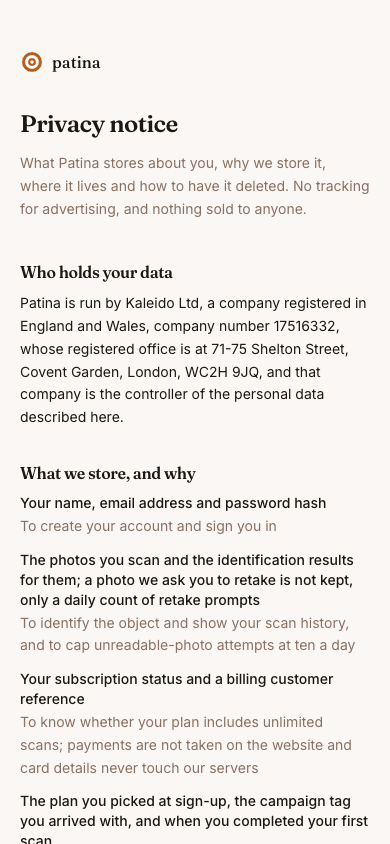
Because history means storage, the short version: Patina keeps the photos you scan and their identification results while your account exists, which is exactly what makes history keep working, and the flagged status and appraiser referral ride along with the scan they belong to. Those referral links go to independent services we have no partnership with, and they carry a tag naming Patina, never anything about you or your scan. The application runs on Amazon Web Services in the United States, and scan photos are processed by Anthropic's AI model to produce the identification.
There is no self-serve export or deletion inside the app today. You ask us instead, by writing from your account email to the contact address on our website, and we remove the account, its photos and its history within thirty days. Our page on what happens to the photos you scan sets out the rest, including everything else we store and the certifications and residency options we do not have.
Patina is not open yet
We are building in the open and running a waitlist. Nothing on this page is a report of what other collectors have found, because nobody has used Patina in the wild yet. It is a description of what the product is built to do: identify what you are holding, say how sure it is, point you toward an appraiser when it is not sure, and keep the last ten answers where you can find them. The terms and privacy policy on this site name the company that sells Patina. If this is the tool you were searching for, join the waitlist and we will tell you when it opens.
Questions
Is there an app that scans collectibles for value?
Several services will offer you a price estimate. Patina will not. We identify: maker, era and origin from a photo, with a confidence level. We never invent a dollar value, because a credible figure depends on condition, market and provenance that a photo cannot settle. When a result needs a real valuation, Patina flags it and links you to an appraiser.
How many scans does the history keep?
Your last ten scans, tied to your signed-in account. Older scans roll off the list, so if a find matters to you, note the details down while it is still showing.
Does my scan history follow my account?
Yes. History sits behind a sign-in rather than on a device, and you sign in with an email address and a password. The last ten scans on that account are what the history screen shows.
Do I need an account to use the scanner?
Yes. Patina is auth-gated, and you sign in with an email address and a password. The account is what your scan history and your monthly scan allowance belong to.
Is scan history only on the paid plan?
No. Both plans include scan history of your last ten scans.
Can I export or bulk delete my scans?
Not from inside the app yet. Self-serve export and self-serve deletion are not built. You can ask us to delete your account by writing from your account email to the contact address on our website, and we remove the account, its photos and its scan history within thirty days.
Does it work on cards, coins and other collectibles?
Patina is built for antiques and older objects, the marks, signatures and construction details a collector squints at. It is not a card or coin grading tool, and it does not assign grades. When it cannot place something with confidence, it says so rather than guessing.
How accurate is the identification?
Every result is an AI-generated estimate rather than an expert appraisal, and it can be wrong, which is why each one carries a confidence level and why low-confidence results come with an appraiser referral. Our page on how accurate AI antique identification is goes through the limits properly.