Is an appraisal worth it for one item? What the triage flag is for
Whether an appraisal is worth it for one item depends on whether an expert would actually change the answer, and that is the part you cannot judge alone with a phone in a crowded room.
Patina is not open yet, so anything on this page about what it does is what it is being built to do.
One item, one question, and an uncomfortable sum
If you have a single object and a single question, the arithmetic feels wrong before you start. A written appraisal is priced for a piece of professional work, not for a curiosity, and appraisers commonly bill by the hour or by the item, so the fee does not shrink just because you only brought one thing. We are not going to quote you a figure we cannot source, and you should treat any page that does, without saying where the number came from, with the same caution you would give an unmarked hallmark.
So the honest answer to whether an appraisal is worth it for one item is that it depends on something you probably cannot see yet: whether this is the kind of object where an expert eye genuinely changes the answer.
The two ways this usually goes wrong
The first is paying for expertise you did not need. The mark reads clearly, the form is well documented, the piece was made in quantity for decades, and a professional spends twenty minutes confirming what a good reference book would have told you. Nothing was harmed except your wallet.
The second is the one collectors talk about more quietly. You pass on the fee, sell the thing at the price a stranger offered, and later find out the signature you could not read was worth reading. That is the sleeper, and it is the reason people ask this question at all.
Between those two outcomes there is a step almost nobody does deliberately, because until now it has been guesswork: triage. Deciding, with some reasoning behind it, which of your objects deserves a human. That is the step Patina is built for.
How the triage flag works
- Photograph the piece, or choose a photo you already took
Patina runs in your phone's browser. Shoot the object where it stands, on the table at the estate sale or on the kitchen counter at home, or pick a shot from your library if you already photographed the find and walked away still wondering. Both routes are there on the capture screen, within thumb reach.
- The model returns maker, era, origin and a confidence level
An AI vision model reads the photo and gives back what it thinks the object is, along with how confident it is in that reading. The confidence level is not decoration, it is the input the next step runs on.
- You get a plain-English result screen, never a price
The result reads like a knowledgeable friend talking, not a database dump, and it carries a persistent disclaimer that this is an AI-generated estimate rather than an expert appraisal, and not a basis for a purchase or sale decision. There is no dollar value anywhere on it, because valuation is someone else's job and we will not invent a number to look clever.
- Below the confidence threshold, the flag appears
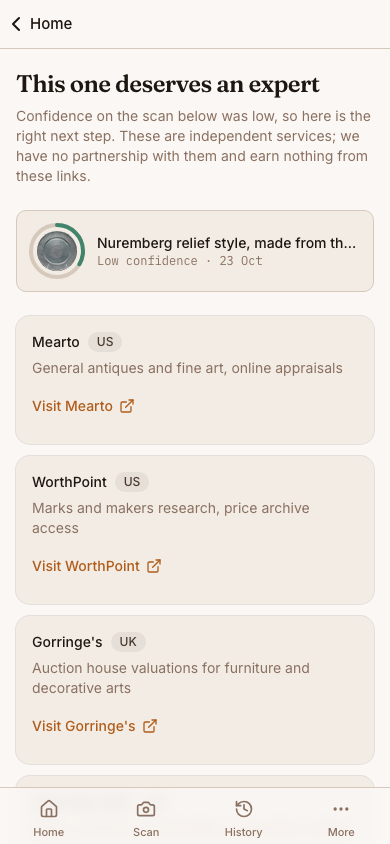
When confidence falls under Patina's threshold, the result screen raises the triage flag: our read of this object is not strong enough to lean on, and this is the point where a human should look. The flag comes with a referral link to an appraisal service, so your next step is a tap rather than an evening of searching.
What the flag actually gives you
A reason to spend, or a reason not to
The flag is tied to a specific weak identification of a specific object, so "get this looked at" arrives with something behind it instead of general anxiety about everything in the box.
A next step that already exists
When a result is flagged, the referral link to an appraisal service sits right there on the screen. You are not starting from a search box at eleven at night, comparing names you have never heard of.
No invented number steering the decision
Patina never shows a dollar value. That means the choice to pay for an appraisal is made on how well the object is identified, not on a made-up figure that flatters or deflates what you are holding.
Triage before you commit any money
The free plan includes three identifications a calendar month, enforced server-side, which is enough to ask the question of a single find without paying anyone.
A second opinion, framed as one
The persistent AI-estimate disclaimer stays on the result screen on purpose, and your last ten scans stay in your history so you can go back to the reading later. You keep your own knowledge and your own judgement; Patina is the other voice in the room, not the verdict.
Where Patina stops and an appraiser starts
Patina identifies. It does not appraise, authenticate, or value, and it is not built to be the basis of a purchase or sale decision. Every result screen says so, in words, every time, because an identification from a vision model is an estimate and pretending otherwise would be the one thing that makes this product worse than useless.
What that means practically: if you are deciding whether to insure something, settle an estate, or sell at auction, you want a human with credentials and a signature, and the triage flag is there to point you at one. If you are standing in a garage with four minutes before someone else picks the thing up, you want a fast, honest read on what it probably is, and a clear signal about whether that read is solid.
About the referral link
The appraisers behind the flag are independent services. We have no partnership with them, so treat the referral as a shortcut to somewhere sensible rather than an endorsement from us, and choose on the strength of the service rather than on the fact that we listed it. The link carries a tag naming Patina and nothing about you or your scan, and we record the click so we can tell which referrals are actually useful. We would rather write that plainly here than bury it, because a triage flag that quietly pushed everyone toward a paid appraisal would not be triage. It is confidence-gated: it appears when confidence is below threshold, not when it suits us.
Today, Patina is a waitlist
The product is not open to everyone yet, so everything on this page is what Patina is built to do, not a report from people already using it. You can join the waitlist now, and when accounts open you sign in with an email address and password. Photos and results are processed by Anthropic to identify the object and stored on Amazon Web Services in the United States while your account exists, so your scan history keeps working. If you ask us to delete the account from your account email, we remove it, its photos and its history within 30 days.
Questions
So is an appraisal worth it for one item?
It is worth it when an expert's reading of the object would change what you do next, and it is usually not worth it when the piece is well documented and clearly marked. Patina's triage flag is built to tell you which situation you are in, by flagging the results where its own confidence is too low to rely on.
Does Patina tell me what my item is worth?
No, and it never will. Patina returns maker, era and origin in plain English with a confidence level, and the result screen carries a persistent AI-estimate disclaimer. Identification is our job; valuation belongs to a qualified human.
How does Patina decide when to raise the flag?
The vision model returns a confidence level alongside its reading of the photo. When that confidence falls below Patina's threshold, the result screen raises the appraisal triage flag and shows a referral link to an appraisal service.
What if the result is confident? Does that mean I do not need an appraiser?
It means our read of the object is strong, not that the object is ordinary or that no expert could add anything. A confident identification is a second opinion you can weigh against your own knowledge, not a substitute for professional appraisal where money or insurance is on the line.
Are the appraisers you link to partners of yours?
No. They are independent services we have no relationship with, and the link carries a tag naming Patina, never anything about you or your scan. We record clicks so we know which referrals are worth keeping, which is exactly why the flag is gated on confidence rather than shown on every result.
Can I try this without paying?
Yes. The free plan gives you three identifications a calendar month, including the confidence level, the appraiser referral when a result needs an expert eye, and a history of your last ten scans.
Can I use a photo I already took?
Yes. The capture screen offers both taking a photo with your phone's camera and choosing one from your library, so a shot you took at the sale last weekend works as well as the object in front of you now.
Is Patina available now?
Patina is at the waitlist stage today, so this page describes what it is built to do rather than reviews from people using it. Join the waitlist and we will tell you when accounts open.