Photograph it, and get maker, era and origin in plain English
Patina is an antique identifier app for the phone in your pocket: photograph the piece you are holding and it returns a maker, an era, an origin and a confidence level, in plain English. It never puts a dollar value on your find, because identifying an object and valuing one are two different jobs done by two different kinds of expert.
Patina is not open yet, so anything on this page about what it does is what it is being built to do.
The problem with identifying something while you are standing in front of it
You have a few minutes. The table is crowded, someone else is circling the same box lot, and the object in your hands has a mark you cannot read, a glaze you half recognise, and a shape that could be period or could be 1974.
The usual tools do not fit that moment. A general image search is built to sell you something similar, so it hands back modern reproductions of the thing you are holding, which tells you nothing about the thing you are holding. Mark and hallmark reference charts are excellent, and they assume you can already read the mark well enough to look it up, which is exactly the part you are stuck on. A proper appraisal is the right answer for a serious piece and the wrong answer for a nine dollar maybe, because it costs real money and takes real time, and you have neither on the floor of an estate sale.
So most collectors fall back on the binary: pay for expertise you may not need, or guess and find out later. Patina exists to put something honest in the middle of that binary. It is a second opinion you can get from a photograph, phrased the way a knowledgeable friend would phrase it, and clear about how sure it is.
How identification works in Patina
- Photograph the object
Open Patina in your phone browser and the camera opens with it, pointed at whatever is in front of you. Fill the frame with the piece, or with the mark on its base if the mark is the puzzle. Today capture is camera-only, so this is a photo you take in the moment rather than one you pick from your gallery.
- The photo goes to a multimodal vision model
Patina sends the image to a vision model from Anthropic with instructions specific to antiques and collectables, rather than to a general image matcher. The question it is asked is not what looks like this online, but what object is this, when and where was it likely made, and by whom.
- You get four things back, in plain English
A likely maker, an era, an origin, and a confidence level for the reading. No jargon you have to decode, no wall of visually similar listings, no page of caveats hedged into uselessness. If the model is working from a blurry mark or an ambiguous form, the confidence level is where that shows up.
- The disclaimer stays on the screen with the answer
Every result screen carries a persistent note that what you are reading is an AI-generated estimate rather than an expert appraisal. It is not tucked into a settings page or shown once at sign-up, because the moment you most need to remember it is the moment you are reading a confident-sounding answer.
- No dollar value, deliberately
Patina will not tell you what a piece is worth, and it is not withholding a number it secretly has. Valuation depends on condition in the hand, provenance, and what the market did last month. Identification is our job, and we would rather give you a good name and date than a bad price.
What that gives you
An answer shaped like an answer
Maker, era, origin. Three fields you can act on, write on a tag, or take to a specialist, instead of thirty similar-looking product photos you then have to interpret yourself.
A starting point when the mark defeats you
The hardest searches are the ones where you cannot read the thing you would need to type. Photographing an illegible signature or a worn hallmark gives Patina something to reason from, which is more than an empty search box gives you.
Confidence stated, not implied
Every reading comes with how sure it is. A high-confidence identification and a coin-flip guess look different on the screen, so you can tell which one to lean on and which one to treat as a lead worth checking.
Language you can repeat out loud
The result screen is written in plain English, so you can read it back to the person running the sale, or to the dealer at the next table, without translating database shorthand first.
No number that could push you into a bad decision
Because Patina never estimates value, it cannot talk you into overpaying or into passing on something cheap. The decision to buy, sell or walk away stays yours, made on evidence you can see.
What we are not claiming
We would rather be precise about this than sell you certainty we do not have.
An identification from Patina is a model's best reading of a photograph. It can be wrong, particularly on reproductions built to imitate period work, on pieces whose marks have worn away, and on categories where the difference between genuine and copied lives in weight, sound or tool marks that a camera cannot capture. Nothing Patina returns is an appraisal, an authentication, or a basis for a purchase or sale decision on a piece that matters to you. For those, a human expert with the object in hand is still the right next step, and the result screen says so alongside every reading.
Patina is also pre-launch. The identification path is built, and it has not yet been verified end to end on a public build, which is why we are running a waitlist rather than a launch. When a real photograph resolves to a real maker, era and origin on the deployed app, reliably enough that we would hand it to a collector, that is when we open the doors. We will not describe it as working before it demonstrably does.
What happens to your photo
The photos you scan and the results for them are stored with your account so your history keeps working, on Amazon Web Services in the United States, and the image is processed by Anthropic's model to produce the identification. If you want it all gone, you can write to us from your account email and we remove the account, its photos and its history within thirty days.
What identification will cost
Free
Free
The occasional finder or inheritance receiver who meets an unfamiliar object a few times a year and needs to see a real result before paying anything.
- Scans per month: 3
- Scan history: Last 10 scans
- Maker, era and origin from a photo
- Honest confidence level on every result
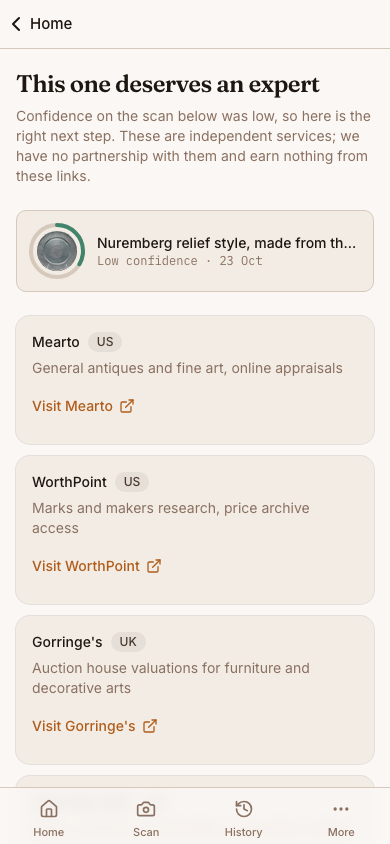
- Appraiser referral when a result needs an expert eye
- Scan history of your last 10 scans
Unlimited
$6.99 / month
The estate sale regular or serious thrift shopper who meets unfamiliar objects several times a month and wants to scan every one of them.
- Scans per month: Unlimited
- Scan history: Last 10 scans
- Dollar values: Not provided
- Unlimited scans every month
- Maker, era and origin from a photo
- Honest confidence level on every result
Questions
Is there an app that can identify antiques from a photo?
That is what Patina is built to do. You photograph the object with your phone, and a multimodal vision model returns a likely maker, an era, an origin and a confidence level, written in plain English. It is a second opinion rather than a verdict, and it is not a substitute for an appraisal on a piece that matters.
Can I upload a photo I already took?
Not yet. Capture today is camera-only, so on Android Chrome and iOS Safari the camera opens directly and you photograph the object in front of you. Choosing an existing image from your gallery is not available in the current build.
Will it tell me what my item is worth?
No, and that is a deliberate choice rather than a gap. Patina never shows a dollar value. Value depends on condition in the hand, provenance and current market appetite, which a photograph cannot settle. We identify; valuation belongs to an appraiser.
How reliable is the identification?
It is a model's best reading of one photograph, so treat it as a lead rather than a conclusion. Every result carries a confidence level and a persistent note that it is an AI-generated estimate, not an expert appraisal, and not a basis for buying or selling. Reproductions, worn marks and categories that depend on weight or tool marks are where a photo is weakest.
Can it read a maker's mark or a signature I cannot make out?
You can fill the frame with the mark instead of the whole object, and the model reasons from what it can see there. What comes back is the same set of fields, maker, era, origin and confidence. If the mark is too worn or too ambiguous to support a reading, that shows up as low confidence rather than as an invented name.
Is there a free version?
Yes. The free plan includes three identifications a calendar month with the full result screen, a confidence level on every reading, an appraiser referral when a result needs an expert eye, and your last ten scans in history.
Can I use it now?
Patina is on a waitlist while we verify the identification path end to end on a public build. Join the waitlist and we will write to you when a photograph reliably resolves to a maker, era and origin on the deployed app.